No. 1 · 7 November 2026
Notes
An OS inside your OS. What six years of the malleable software community taught us about making software fit people.
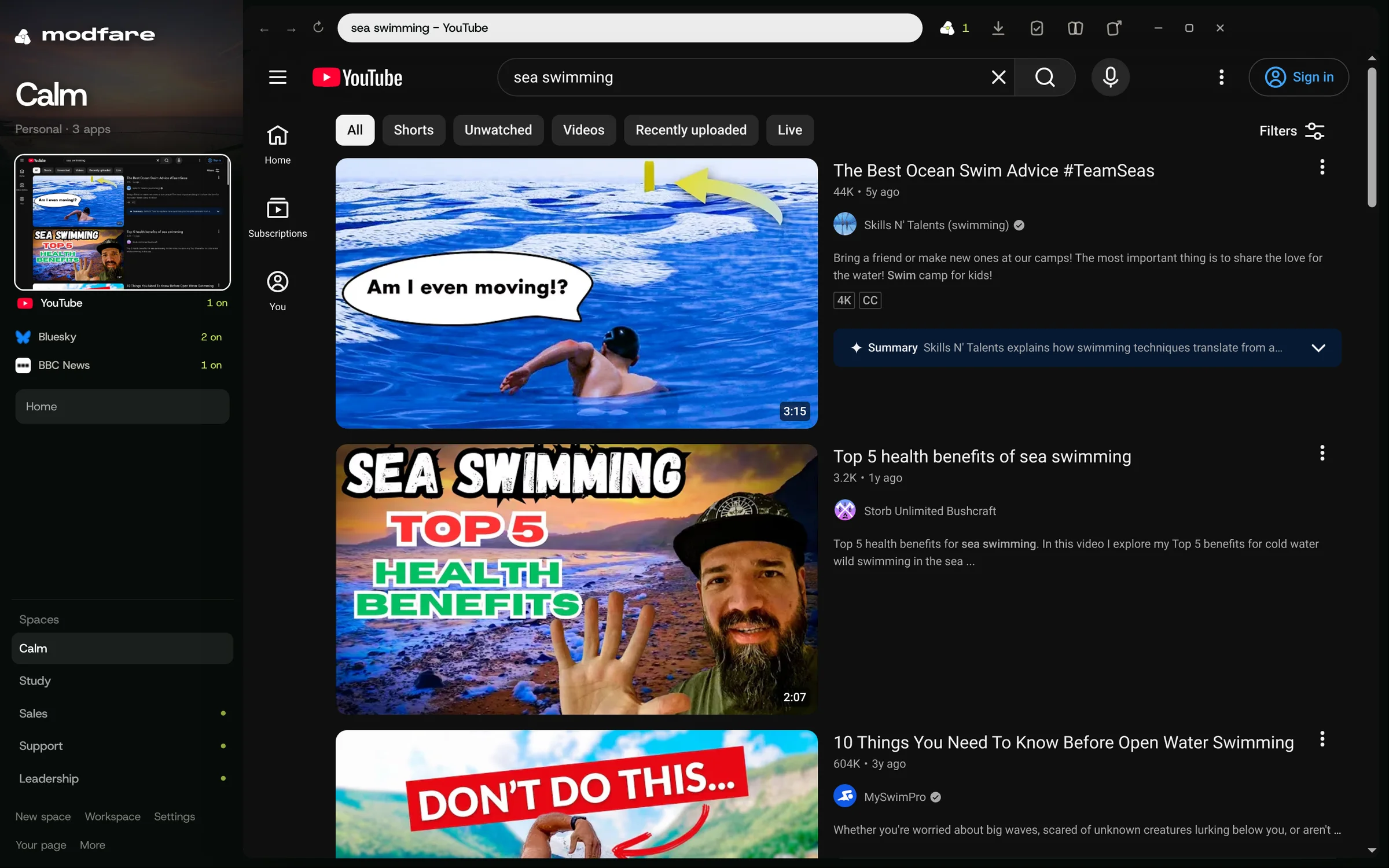
Why an OS inside your OS
Personal computers were promised as clay: material anyone could reshape. Instead we got appliances. Ink & Switch’s essay Malleable software puts it plainly, and the Malleable Systems Collective has spent six years asking how to get the clay back.
Our bet is that you don’t get there by asking people to move into a new app. You get there by sitting on top of the apps they already have, and letting them change those, a little at a time. Modfare is that layer: a workspace made of your existing software, with a gentle slope from asking for a change to building one.
What the community talked about
We read all 6,671 messages from the Malleable Systems Collective’s chat, and every link people shared. The conversation in 2021 was about the great malleable systems of the past: Smalltalk, Lisp machines, Emacs. By 2024 it was about AI.
Show the numbers
| Year | Messages | Smalltalk, Lisp, Emacs | AI |
|---|---|---|---|
| 2021 | 2,259 | 77.0 | 0.4 |
| 2022 | 1,843 | 53.7 | 0.0 |
| 2023 | 1,379 | 18.9 | 16.7 |
| 2024 | 849 | 34.2 | 38.9 |
| 2025 | 256 | 19.5 | 0.0 |
| 2026 | 85 | 11.8 | 82.4 |
FindingThe tools changed, the wish didn’t. Again and again people asked for software they could bend without becoming programmers. Language models are the first tool that makes that wish ordinary.
The rules Modfare starts from
Four rules for changing other people’s software, kindly.
- Mark, never delete. Changes that can always be undone are changes people dare to make.
- On the device. What someone chooses to change says something personal. It shouldn’t leave their computer.
- Small pieces, not whole pages. Judge a post, a card, a comment. Never hide a whole page for one word.
- Lenses plug in. A registry of small, pure judges lets new kinds of change join without touching the core.
A gentle slope
Most people will only ever ask. Some will open a mod to see how it works. A few will write lenses for everyone else. The design job is to make each step up feel small: plain words first, a readable mod second, code last, and never required.
Open questions
- How should a mod say it’s for one site’s layout, and survive that site changing?
- What does credit look like when a mod is remixed a hundred times?
- Where should an agent stop and ask? Our default: before anything leaves the device, or costs money.
References
- Geoffrey Litt, Josh Horowitz, Peter van Hardenberg, Todd Matthews. Malleable software: Restoring user agency in a world of locked-down apps. Ink & Switch, 2025.
- Martin Kleppmann, Adam Wiggins, Peter van Hardenberg, Mark McGranaghan. Local-first software. Ink & Switch, 2019.
- The Malleable Systems Collective, and its public chat, 2021 to 2026.
The tools changed, the wish didn’t. People still want software they can bend without becoming programmers.
Make the internet yours.
Modfare is in early preview for Mac and Windows. Each download comes with a few mods to start from.